Categories
Events

Mon 15 Dec 2025: FashionTech & the Future of Wearable Designs

Date:

Monday 15 December 2025, 11:00 am to 12 pm

Location:

Canberra Museum & Gallery

176 London Cct, Canberra ACT 2601, Australia

Link to register:

https://events.humanitix.com/free-talk-fashiontech-and-the-future-of-wearable-designs

Abstract

Anouk Wipprecht, Dutch FashionTech Designer

Join visionary Dutch FashionTech designer Anouk Wipprecht as she explores how fashion, science, and technology merge to shape the future of wearable design. From her iconic Spider Dress to collaborations with Intel, Disney, and Cirque du Soleil – Wipprecht’s talk will delve into the exciting frontier where fashion becomes interactive and technology meets the human body.

Drawing on machine learning, biomimicry, sensors, and animatronics, Wipprecht’s designs behave like living systems – breathing, reacting, and redefining how we interact with our environment. She invites us to imagine a future where clothing doesn’t just express who we are, but actively interfaces, protects, and communicates with the world around us.

A Public Talk with Anouk Wipprecht presented by University of Canberra’s Collaborative Robotics Lab in collaboration with Canberra Museum + Gallery. Part of the UC-CRL Robots Among Us talk series.

Categories
Events

Wed 12 Nov 2025: Digital Civics: Rethinking Citizenship and Community Advocacy in the Age of Datafication and genAI

Date:

Wednesday 12 November 2025, 11:00 to 12:00 pm

Location:

News and Media Research Centre, University of Canberra

Link: Register here

Abstract

As cities become increasingly datafied and algorithmically governed, the role of digital media in shaping civic participation, public voice, and community advocacy is more critical than ever. In this talk, Professor Marcus Foth explores the conceptual and practical groundwork that drives a national research collaboration between QUT and civil society organisations focused on participatory data practices, digital rights, and community empowerment. The talk introduces the notion of a Living Data Lab, that is, a participatory civic infrastructure designed to support data literacy and digital inclusion, community-led storytelling, and grassroots political advocacy backed by genAI. It responds to growing concerns about opaque data regimes, tokenistic engagement practices in urban planning, and the erosion of public trust by championing co-designed, accessible, and ethical alternatives to top-down smart city approaches. Drawing on years of interdisciplinary work across urban informatics, critical data studies, and digital civics, Prof. Foth reflects on how participatory approaches to data visualisation and advocacy can enable citizens to contest extractive data logics, defend civil liberties, and shape just urban futures. This talk offers timely provocations for scholars in media and communication studies, digital inclusion, and civic tech who are interested in reimagining digital civics in an era of genAI and datafication.

Biography

Professor Marcus Foth

Marcus Foth is a Professor of Urban Informatics in the School of Design and a Chief Investigator in the QUT Digital Media Research Centre (DMRC), Faculty of Creative Industries, Education, and Social Justice, Queensland University of Technology, Brisbane, Australia. For more than two decades, Marcus has led ubiquitous computing and interaction design research into interactive digital media, screen, mobile and smart city applications. Marcus founded the Urban Informatics Research Lab in 2006 and the QUT Design Lab in 2016. He is a founding member of the QUT More-than-Human Futures research group. Marcus has published more than 290 peer-reviewed publications. He is a Fellow of the Australian Computer Society and the Queensland Academy of Arts and Sciences, a Distinguished Member and Distinguished Speaker of the Association for Computing Machinery (ACM), and currently serves on Australia’s national College of Experts.

Related Readings:

Mann, M., Mitchell, P., Foth, M., & Anastasiu, I. (2020). #BlockSidewalk to Barcelona: Technological sovereignty and the social license to operate smart cities. Journal of the Association for Information Science and Technology, 71(9), 1103–1115. https://doi.org/10.1002/asi.24387

Foth, M., Anastasiu, I., Mann, M., & Mitchell, P. (2021). From Automation to Autonomy: Technological Sovereignty for Better Data Care in Smart Cities. In B. T. Wang & C. M. Wang (Eds.), Automating Cities: Design, Construction, Operation and Future Impact(pp. 319–343). Springer. https://doi.org/10.1007/978-981-15-8670-5_13

Foth, M., Emamjome, F., Mitchell, P., & Rittenbruch, M. (2022). Spatial data in urban informatics: Contentions of the software-sorted city. In S. Carta (Ed.), Machine Learning and the City: Applications in Architecture and Urban Design (pp. 367–378). Wiley.https://doi.org/10.1002/9781119815075.ch28

Sheikh, H., Foth, M., & Mitchell, P. (2023). From Legislation to Obligation: Re-thinking Smart Urban Governance for Multispecies Justice. Urban Governance, 3(4), 259-268. https://doi.org/10.1016/j.ugj.2023.09.003

Categories
Past events

Mon 13 Oct 2025: Research on Nonverbal Information and XR to Enrich Future Telecommunications

Date:

Monday, 13 October 2025, 11:00 am to 12:00 pm

Location:

In person: Data61 Immersive Environments Lab, Acacia Room, Ground Floor, Building 801, CSIRO Black Mountain (please email Mingze.Xi@data61.csiro.au to sign-in)

Online: Join in on Teams

Abstract

In future telecommunications, it is expected that people will be able to communicate with each other in the cyber/virtual space with objects and information from the physical/real space they are located. The successful key to realize such rich telecommunication is to unlock “communication with nonverbal information” by appropriately conveying the subtleties of “non-spoken signals,” which plays an important role in our daily interpersonal understanding. In this talk, the future of rich telecommunication through appropriate transmission and reception of nonverbal information and XR technologies will be discussed with my colleagues.

Biography

Yoshifumi Kitamura is Professor at Research Institute of Electrical Communication, Tohoku University. From 2023, he also serves as Director of the Interdisciplinary ICT Research Center for Cyber and Real Spaces. His research interests include interactive content design, human computer interactions, 3D user interfaces, virtual reality, and related fields. He has been active in academic and professional communities, and serves in positions such as Japan Liaison for IFIP TC-13 (Human-Computer Interaction) (2012-), the Liaison for Japan and Chair of ACM SIGCHI Asian Development Committee (2015-2021), Chair of Japan ACM SIGCHI Chapter (2016-2021), Steering Committee Chair of ACM VRST, SIGGRAPH Asia 2015 Conference Chair, ACM CHI 2021 General Chair, and so on. His notable awards received include such as the ACM SIGCHI Lifetime Service Award (2025), and he was inducted into the IEEE VGTC Virtual Reality Academy (2024).

Categories
Past events

Fri 22 Aug 2025: Robotics for Good: A Human-Centered Mobility Solution for People with Visual Impairments

Date:

Friday, 22 August 2025, 1:30pm to 2:30pm

Location:

University of Canberra, Building 02, B09.

This event is brought to you by the Collaborative Robotics Lab, The University of Canberra.

Abstract 

With an estimated 253 million people worldwide and 500,000 in Australia living with blindness or low vision, there remains a significant gap in solutions that support fluid mobility and social participation. In response, we — in partnership with Guide Dogs NSW/ACT and supported by the ARC and TPG — are developing an AI-powered robotic system to enhance independence and mobility for those who need it most.

Built on a quadrupedal robotic platform, the system integrates advanced perception, social-aware locomotion, and intuitive human–robot interaction through appropriate feedback. This human-centred technology enables confident navigation across complex environments such as stairs, tight corridors, and busy areas. Designed in collaboration with the blind community and guide dog experts, the robotic guide is expected to provide reliable navigation assistance while fostering greater confidence in everyday life. It represents a scalable, inclusive step forward in assistive mobility technology.

Biography 

Professor Sarath Kodagoda is a leading expert in robotics and mechatronics, driving innovation in research, education, and industry. As Director of the UTS Robotics Institute, former President of the Australian Robotics & Automation Association (ARAA), and NSSN ambassador, he has significantly contributed to advanced robotics in Australia. With over 25 years of experience, his expertise lies in robotic sensing and perception, earning him eight prestigious awards, including international water industry accolades. A passionate educator, he pioneered UTS’s mechatronics courses, received three teaching awards, and integrated research into education. He has published over 200 articles, secured major grants, and serves as Technical Editor for IEEE Transactions on Mechatronics.

Categories
Past events

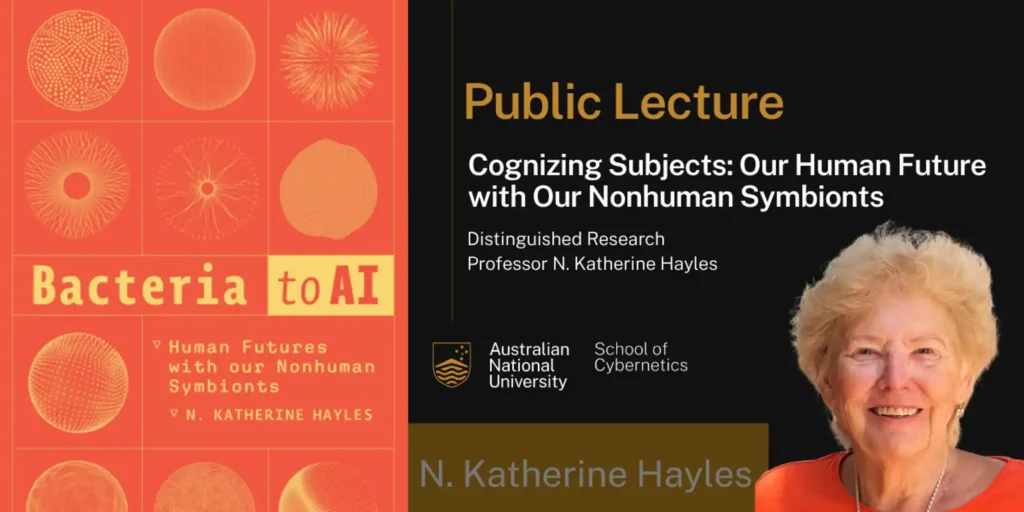
Wed, 10 Sep, 5pm – 7pm AEST: N. Katherine Hayles – Cognizing Subjects: Our Human Futures with Our Nonhuman Symbionts.

Date

Wed, 10 Sep, 5pm – 7pm

Location

ANU Birch Building (#35) Innovation Space, Level 2, Acton ACT, Australia.

Register

This event is brought to you by the School of Cybernetics at The Australian National University.

This thought-provoking lecture challenges human-centred views of intelligence, introducing the Integrated Cognitive Framework—a model that recognises cognition in humans, AI, and nonhuman life. Through case studies spanning microorganisms to large language models, Hayles explores how embracing ecological relationality can lead to flourishing futures for all species.

Hosted by Professor Chris Danta, from the ANU School of Cybernetics, this public lecture is supported by the Australian Research Council through the Future Fellowship Future Fables: Literature, Evolution and Artificial Intelligence. The session aims to spark fresh thinking on our place in the web of life, the future of AI, and what it means to thrive alongside our nonhuman symbionts. Don’t miss this opportunity to hear one of the most influential voices in science, technology, and literary studies, as she shares insights from her latest book Bacteria to AI.

Abstract

Cognizing Subjects: Our Human Futures with Our Nonhuman Symbionts

Among the practices driving the planet toward ecological collapse is anthropocentrism, the belief that Homo sapiens is the species superior to all others.  Such ideas find support in the notion that humans are cognitively the most advanced. Crucial to bringing sanity, sustainability and ecological balance back, then, is a reassessment of cognition. The Integrated Cognitive Framework (ICF) proposes a relational definition of cognition as a process that interprets information in contexts that connect it to meaning. This definition opens cognitive practices as well as meaning-making to nonhuman lifeforms and to AIs such as Large Language Models. In developed societies, most of the work is performed by cognitive assemblages, collectivities of humans, nonhumans and computational media through which information, interpretations, and decisions flow. 

The broader context within which ICF operates is ecological relationality. Its implications are explored through case studies, including the cognitive capacities of microorganisms. The cognitive capabilities of computational media are explored through analyses of the architectures and textual productions of Large Language Models, specifically OpenAI’s Transformer models. Replacing liberal political philosophy with ecological relationality enables us to take responsibility without at the same time reinscribing human dominance, and for embracing choices that will lead to flourishing futures for humans and nonhumans.  

Biography

N. Katherine Hayles is the Distinguished Research Professor at the University of California, Los Angeles, and the James B. Duke Professor Emerita from Duke University.  Her research focuses on the relations of literature, science and technology in the 20th and 21st centuries. Her twelve print books include Postprint: Books and Becoming Computational (Columbia, 2021), Unthought: The Power of the Cognitive Nonconscious (Univ. of Chicago Press, 2017) and How We Think: Digital Media and Contemporary Technogenesis (Univ. of Chicago Press 2015), in addition to over 100 peer-reviewed articles. Her books have won several prizes, including The Rene Wellek Award for the Best Book in Literary Theory for How We Became Posthuman: Virtual Bodies in Literature, Cybernetics and Informatics, and the Suzanne Langer Award for Writing Machines. She has been recognized by many fellowships and awards, including two NEH Fellowships, a Guggenheim, a Rockefellar Residential Fellowship at Bellagio, and two University of California Presidential Research Fellowships. She is a member of the American Academy of Arts and Sciences. Her latest book is Bacteria to AI: Human Futures with Our Nonhuman Symbionts, published by the University of Chicago Press in 2025.

Categories
Past events

Thu 13 Mar 2025: Professor Phillip Morgan, Cardiff University

Date

Thursday 13 March 2025, 5:30 pm – 7:30 pm AEDT

Register

Location

University of Canberra, Building 1 Level A Room 21 (1A21), near Mizzuna Cafe

Title

How to prevent an AI and robot apocalypse: Designing and deploying AI, robots and other autonomous systems responsibly, safely, securely and ethically

Abstract

Over the past 15-20 years, we have seen rapid technological developments in AI, robotic and autonomous systems such that they are fast becoming ubiquitous within many workplace domains (e.g. healthcare, logistics, manufacturing, transport) and are becoming ever present within domestic and social contexts. Self-driving cars, industrial and domestic robots, augmentation of reality, and smart AI agents are no longer something of fiction. Such technologies can, for example: increase productivity; complete repetitive tasks; streamline operations; reduce errors, incidents and accidents typically caused by humans; and in a growing number of cases – support decision making. However, they are not flawless, yet are being developed and deployed at a rapid pace. Lisanne Bainbridge (1983) warned of the ‘ironies of automation’; Raja Parasuraman and Victor Riley (1997) the ‘misuse, disuse, and abuse of automation; John Lee and Katrina See (2004) ‘designing automation for appropriate reliance’; and Alexandra Kaplan and colleagues (2023) ‘factors that have no bearing on AI performance impacting trust in AI’. Are we then risking an AI and robot apocalypse? A judgement day? Quite possibly! Unless such technologies are designed, developed, and tested responsibly, safely, securely, and ethically by humans and crucially with end-users. I will present example research findings, recommendations, notes of caution and many tales of hope from projects spanning a 20+ year career (to date) in Human Factors Psychology and Cognitive Science – across application domains including aerospace, defence, emergency services, environmental intelligence, healthcare, and transportation. Furthermore, almost all these technologies are at risk of being cyber attacked, due to us – humans – often being the weakest link. I will discuss how we can better understand and measure our cyber vulnerabilities in order to fight back and achieve a state of seamless security and privacy in symbiosis with the AI, robotic and autonomous systems in which we increasingly share the world with.

Agenda

  • 5:30 pm – Networking
  • 5:45 pm – Acknowledgement of Country
  • 6:00 pm – Guest talk by Prof Philip Morgan
  • 6:45 pm – Panel Discussion moderated by Prof Chris Wallace (https://researchprofiles.canbe…)
  • 7:15 pm – Q&A session
  • 7:30 pm – Conclusion

Speaker’s Bio

Phillip Morgan – Professor of Human Factors and Cognitive Science
School of Psychology, Cardiff University, UK

Prof Phil Morgan holds a Personal Chair (as a Senior Professor) within the School of Psychology at Cardiff University. He is Director of the Cardiff University Human Factors Excellence (HuFEx) Group, Director of Research within the Centre for AI, Robotics, and Human-Machine Systems (IROHMS), Transportation and Human Factors and Cognitive Science Lead within the Digital Transformation Innovation institute (DTII), Director of the Airbus – Cardiff University Academic Centre of Excellence in Human-Centric Cyber Security (H2CS) and Co-Academic Lead of a partnership between Airbus and Cardiff University. Prof Morgan is also Visiting Professor at Luleå University of Technology – Psychology, Division of Health, Medicine & Rehabilitation, Sweden, and Distinguished Visiting Fellow within the Faculty of Education, Science, Technology and Mathematics at the University of Canberra, Australia.

Formally trained as a Cognitive Experimental Psychologist, Prof Morgan is an international expert in human aspects of AI and automation, trust in new/disruptive technologies, Cyberpsychology, transportation human factors, HMI design, HCI, interruption and distraction effects, and adaptive cognition and has published extensively (>130 outputs) across these areas. With >50 grants (~£40million, e.g. Airbus, CREST, ERDF, ESRC, EPSRC, HSSRC, IUK, NCSC, SOS Alarm, Wellcome); often as Principal Investigator / Institution Lead, he has significant project management experience. He supervises PhD students (with many past completions) in areas including human aspects of AI, automation, cyber security, transportation and robotics.

Prof Morgan was a Human Factors lead on the IUK (~£5m, 2015-18) Venturer Autonomous Vehicles for UK Roads project, Co-I and Human Factors lead on the IUK (~£5.5m, 2016-19) Flourish Connected Autonomous Vehicles project, PI on an ESRC-JST (~750k, 2020-2023, with universities in Japan – e.g. Kyoto and Osaka) project Rule of Law in the Age of AI: Distributive Liability for Multi-Agent Societies – focussing on factors such as trust, blame and implications for standards and legislation in the event of accidents involving autonomous vehicles. Amongst other current projects, Prof Morgan is Co-Leading a cross-cutting Human-Centred Design Work Package within an EPSRC (~£12m, 2024-2029) AI for Collective Intelligence (AI4CI) hub (https://ai4ci.ac.uk/).

Recently, Prof Morgan established HumaniFAI Ltd – a research and consultancy company focussed on human-centred, assured, ethical, responsible, and safe design and use of AI, robotic and autonomous systems.   

The event is brought to you by the Collaborative Robotics Lab at the University of Canberra and the ACM SIGCHI Chapter for Canberra. The University of Canberra Visiting Distinguished Fellow Scheme has funded Professor Phil Morgan’s visit.

Categories
Past events

Mon 28 Oct 2024: Professor Marcus Foth: More-than-Human Futures

Date:

Monday 28 October 2024, 2:00 pm to 3:00 pm AEDT

Title:

More-than-Human Futures: Connected Urbanism and Cohabitation in the Smart City

Video Recording:

The slides from this event are available here.

Abstract:

The “smart city” agenda is about installing ubiquitous computing infrastructure and IoT devices to drive efficiency and productivity through big data analytics, automation, and optimisation. Yet, what evidence is there to suggest that the smart city can provide genuine answers to the climate emergency and the prospect of a planetary ecocide?

While the smart city agenda has started to move beyond the technology and data hype and come to terms with social and environmental issues, the challenges are vast. Climate change already has a great impact on cities with a notable increase in adverse weather events and insurance and rebuilding costs, and some thought leaders actively seek to reconcile the smart city with the resilient city. This talk ponders the question whether the human-centric focus is in fact worth rethinking in order to imagine the post-anthropocentric city in ‘more-than-human futures.’ With society’s current limited perspective that centres around humans, we risk to forget how we are entangled with and connected to other living beings, the environment, and the wider ecosystem that keeps us alive. Can we reconceptualise the smart city as a place where people and place meet to make a climate-positive contribution to the world?

This presentation will draw on examples from the new book, “Designing More-than-Human Smart Cities: Beyond Sustainability, Towards Cohabitation,” edited by Sara Heitlinger, Marcus Foth and Rachel Clarke published by Oxford University Press, 2024.

Speaker’s Bio:

Professor Marcus Foth.

Marcus Foth is a Professor of Urban Informatics in the School of Design and a Chief Investigator in the QUT Digital Media Research Centre (DMRC), Faculty of Creative Industries, Education, and Social Justice, Queensland University of Technology, Brisbane, Australia. For more than two decades, Marcus has led ubiquitous computing and interaction design research into interactive digital media, screen, mobile and smart city applications. Marcus founded the Urban Informatics Research Lab in 2006. He is a member of the QUT More-than-Human Futures research group. Marcus has published more than 280 peer-reviewed publications. He is a Fellow of the Australian Computer Society and the Queensland Academy of Arts and Sciences, a Distinguished Member of the international Association for Computing Machinery (ACM), and currently serves on Australia’s national College of Experts.

Categories
Past events

Thurs 22 August 2024: A Conversation About Designing Tomorrow

Date

Thu 22nd Aug 2024, 10:30 am – 12:00 pm AEST

Video Recording

Designing Tomorrow

Please join us for a conversation with the authors of the book Designing Tomorrow, Martin Tomitsch and Steve Baty.  

Co-hosted by ACM SIGCHI Chapter for Canberra and the ANU School of Cybernetics, this event includes 30 minutes networking with light refreshments provided from 10.30am to 11am. From 11am to 12pm Martin and Steve will present and invite questions. 

About the book 

We decided to write this book after listening to each other’s talks at the UX Australia conference in August 2021. Hearing Steve share insights from his practice about the far-reaching impact design can create, Martin recognised the connection between his research on life-centredness and strategic design practice. 

Our objective for the book became to combine Martin’s academic knowledge with Steve’s industry experience. We both feel passionate about design and its potential to drive positive change. We believe that we owe it to future generations to enable this change.   

We also realise that we have contributed to the issues discussed in the first three chapters through our research, teaching, and practice. This experience provides us with perspective as well as a responsibility to change what we do and become part of the solution. 

Read more about the book and the authors on:

https://www.designingtomorrowbook.com

Categories
Past events

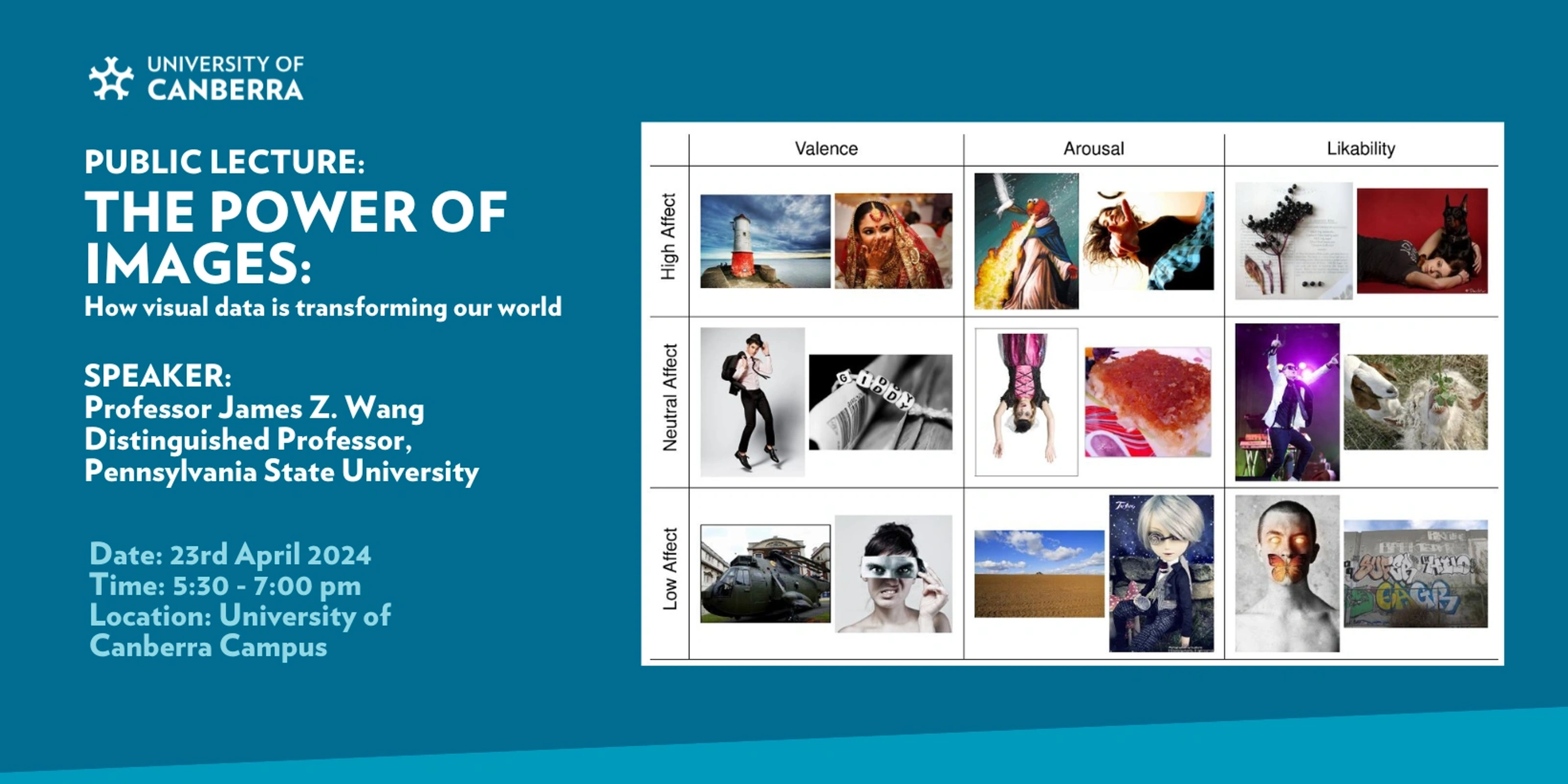
Tues 23 April 2024: Distinguished Professor James Wang, Pennsylvania State University

Date

Tue 23rd Apr 2024, 5:30 pm – 7:00 pm AEST

Title

The Power of Images: How Visual Data is Transforming Our World

Abstract

From the paintings that move us to the medical scans that save lives, images have the power to inform, inspire, and even heal. Distinguished Professor James Wang, a world-renowned expert in visual data analysis, takes you on a journey through the hidden world of images. He’ll reveal how computers are learning to ‘see’ like we do – detecting patterns in medical images for faster diagnosis, guiding robots through complex environments, and even understanding the emotions that a piece of art might evoke.

Prof. Wang’s groundbreaking research explores how images speak to us on multiple levels. Discover how his work is teaching machines to decipher the language of visuals, potentially making them more in tune with human emotions. With fascinating examples and clear explanations, this talk will change how you perceive the vast amount of visual information that surrounds you.

Speaker’s bio

Prof James Z. Wang is the Distinguished Professor of Information Sciences and Technology at The Pennsylvania State University. He received his bachelor’s degree in mathematics summa cum laude from the University of Minnesota, and the MS degree in mathematics, the MS degree in computer science, and the PhD degree in medical information sciences, all from Stanford University. His research interests include image analysis, image modelling, image retrieval, and their applications. He was a visiting professor at the Robotics Institute at Carnegie Mellon University (2007-2008), a lead special section guest editor of the IEEE Transactions on Pattern Analysis and Machine Intelligence (2008), and a program manager at the Office of the Director of the National Science Foundation (2011-2012). He is on the editorial board of the IEEE BITS — The Information Theory Magazine’s special issue on Information Processing in Arts and Humanities (2022). He was a recipient of a National Science Foundation Career Award (2004) and Amazon Research Awards (2018, 2019, 2020).

The event is brought to you by the Collaborative Robotics Lab at the University of Canberra and the ACM SIGCHI Chapter for Canberra.

Categories
Past events

Mon 22 Jan 2024: Associate Professor Andrea Bianchi

Date

Monday 22 January, 2024, 10 – 10.45 am.

Title

“If All You Have is a Hammer”: Designing Digitally Augmented Physical Tools

Abstract

Since the dawn of mankind, the history of the human race is reflected in the history of their tools and their usage. Many of these tools provide augmentation to our physical capabilities: power tools increase the body’s strength, bikes increase locomotion efficiency, and glasses and microscopes increase vision and the human ability to explore the world. However, more interestingly, tools also shape the way we think. It is known that “if all you have is a hammer, everything looks like a nail” (Maslow’s hammer), and to some extent, this is true for any type of tool, as they unconsciously reshape our perception of reality, our consciousness, and our understanding of how to interact with the world surrounding. In this presentation, I show examples of digitally augmented physical tools that shape our perception of reality and give us new perspectives on how to design for supporting prototyping as an exploration activity, and virtual-physical interactions. 

Speaker’s bio

Andrea Bianchi is an Associate Professor in the Department of Industrial Design, an Adjunct Professor in the School of Computing, and the director of the Make lab (make.kaist.ac.kr) at KAIST, in South Korea. He researches in the field of Human-Computer Interaction (HCI) focusing on building tools for prototyping interactive systems, and hardware devices for body augmentation in Mixed Reality. Before joining KAIST, he worked at Sungkyunkwan University (Korea) as a faculty member in the Department of Computer Science, and as a video game programmer for a New York startup. Andrea has published in major venues, including ACM CHI, UIST, and IMWUT, and his work has been recognized with multiple Best Paper Awards and Design Awards. His work has also been covered in the news by Engadget, ZDNet, New Scientist, MAKE, and Gizmodo among others. Andrea received a Ph.D. from KAIST (Korea) in 2012, and his Masters from New York University in 2007.